Wednesday, February 16, 2011

Ghana is too busy at the baby-making factory


Finally, Dr Grace Bediako came out with the preliminary results of the 2010 National Population and Housing Census, the fifth census since Ghana’s independence. Setting the 2010 figures against previous census data lays bare our national population story. It’s not good. We are on the loose. We’ve lost control. Our population growth rate is frightening.

Even a quick look at Ghana’s population growth trends paints a shocking picture and indicates that over time, we the people have the capacity to fill up every inch of space of land in this country with human beings. It appears that while everyone looks on, even people with no mojos are also busy populating the earth. Left to us the individuals alone, we would turn our bodies into baby-making factories regardless of whether we can afford to take care of the children or not.

Ghana’s population growth must be declared a national crisis issue. We must have a national conversation about how to put a lid over this pressing matter. If the current trend of population growth had been a disease, it would have qualified as an epidemic. And this should be. Here are the bare facts, with a simple trend analysis.

Baby-Making Escapades From 1961 to 2010:

The first population census after Ghana became an independent country was conducted in 1961. We recorded a population of 6.7 million as our post-independence baseline figure. What a manageable number! But just nine years afterwards in 1970, we increased to 8.5 million, a 27 per cent increase. Fair enough. Still manageable.

But by 1984, we had almost doubled the 1961 figures and Ghana’s population stood at 12.3 million. Note that the 1970s through 1980s were some of the worst periods of Ghana’s underdevelopment when adventurist soldiers toyed with our governance, rudely moving us through redemption, liberation and revolution – all of no consequence whatsoever.

What baffles me is that during that volatile period, in the midst of famine, torture, fear and hopelessness, we did not relent in the baby-making arena. In the midst of the storm, we sought for solace in warm embracement. So it happened that in spite of our national challenges, we continued to be happy and busy at the groin region, and by such reckless acts of embracement, doubled our population in two decades.

Owing to our industriousness at the baby-making factory, by 1990, our population stood at 17.2 million. Ten years later in 2000, as we entered the new millennium of the Twenty First century, Ghana’s population was about 18.9 million; definitely unmanageable, but still counting. In the most recent census last year, preliminary estimates place our population at 24.2 million.

These figures imply that during the Fourth Republic alone (from the 1990s to the present; in two decades), we have shamelessly (or proudly, depending on your vantage point) topped up our population by about seven million human beings. Eh!!!!!

No wonder the number of young people who sell odds and ends by our roadsides continue to increase and youth unemployment is on the high. These are the children of the Fourth Republic – young, vibrant, unemployable, under-employed or unemployed. And chances are – that they are without hope for the future.

Our population growth trend also implies that since we cut off our apron strings from the Queen of England to become a nation state, in a spate of fifty years (1961 to 2010), Ghana’s population has grown from 6.7 million to the current 24.2 million. Simply put, we have almost quadrupled our population since independence.

Eh!!!! If Osagyefo Dr Kwame Nkrumah should make the mistake of popping out of his plush grave to see his Ghana, he would not recognize our plumb number as against the number of people he inherited at independence.

The rate of our population growth is not sustainable by any stretch of the imagination, whichever way we cut it. We can’t afford it. We can’t manage it, not even with our newly found crude oil status.

If we are to continue on this path of excessive population growth (uncontrolled, encouraged, praised, expected, prayed over), if we continue cranking up the baby-making machine and each of us consider having a baby as the main reason for which God made us – just to populate the earth – then by Ghana’s centenary celebration in 2057, this land will be choked with people.

Even if our population does not quadruple like it did from independence until now but just doubles, there would be about fifty million people on this small land (238,533 sq km – 92,098 sq miles). Fact: The size of our land will not increase. It is reducing. The Atlantic Ocean continues to claim some of our land so by 2057, we would have less land.

A country’s population must be planned; it should not be left to grow organically. What is troubling in the arena of Ghana’s population growth is that it has not just been placed on auto pilot, but that it receives extraordinary encouragement. I dare say that child-making is the one single aspect of our national life that receives the most encouragement than any other.

Baby-Making Obsession:

Baby-making has become a big time business in our country. It is an obsession. It is driven by desperation. It is a life or death endeavour. For women who experience difficulty in getting pregnant, they easily move into a full-time pursuit, with nothing spared.

Desperate women go to unthinkable places and lengths in pursuit of miracle pregnancies. They visit churches, Mallams, fetish priests, drug peddlers, hospitals and anything that propagates hope in their hot pursuits for children. Their lives literally pause, rudely interrupted, while in search of a baby.

Ghana’s population has therefore been left inside churches and prayer camps over intense prayer and fasting. Churches even spring up and operate successfully with baby-making miracle works as the main agenda as if that was the reason Jesus came.

Our society is so unforgiving of people who do not have children. They are looked down upon; they are openly disregarded and gossiped about. They are adjudged failures in life.

Enduring Questions:

Is our culture and super-religiousness creating the obsession for babies, and the urge to have one’s own womb/groin child as against adoption? But must everyone have a child? Some people are not just cut to be parents. However, owing to cultural and religious pressures, everyone seeks to check out their names at the baby-making factory.

Why did this country abandon the aggressive and successful family planning campaigns of the 1980s? Did we solve our population expansion problems or we decided that population control was unimportant?

Something I learned during my school journey is that when you embark on a campaign to effect behavioural change and you stop, progress made does not remain constant. Rather, retrogression can set in and push you into a state worse than the start point of the campaign.

Any successes gained from the family planning campaigns of the 1980s have been mercilessly bombarded and effectively squashed and destroyed at the altar of religious promotion of child birth.

Do we need to embark on a cultural change campaign? Isn’t it about time we embarked on a very aggressive family planning and baby reduction campaigns? Yes, it is past time.

Low-cost Third World attitudes in a little oily country

Third world attitudes are low-cost, big time. You doubt it? Take a cursory look at just two examples: the way we throw garbage away by-heart (‘ba-hat) and the way we drive, recklessly. Attitudinal change is so difficult. Without a doubt, as a people, we don’t have a maintenance culture, a safety culture, a monitoring culture, and an enforcement culture. A culture underlines and defines ones way of life. It shows in traditions, practices, behaviours and attitudes. Positive ways of doing things are at the heart of a nation’s development.
Enters oil waste:

A 28th January 2011 news story filed by Moses Dotsey Aklorbortu, a Daily Graphic correspondent carried the headline, ‘Waste oil pollutes Axim coastline.’ In the story, it is asserted that the waste oil, also known as tar-balls, might have originated from ships that currently frequent our coastline as a result of increased activity over our crude oil find. This means that the waste did not come from Jubilee Fields. Fair enough.

But the story also mentions a major bottom-line matter: ‘The inhabitants of three communities in the Axim municipality — Amanfukumam, Akyinim and Brawire — who are mainly fishermen, cannot use their beaches as a result of the development.’ Sadly, the Ghana Maritime Authority (GMA) could not identify the culprit ships, implying that the ships have gotten away with what should be a criminal act against the state of Ghana. But more seriously, it also suggests that we’re either not equipped to shine our eyes, or we’re not vigilant enough to pin down offenders in this sticky crude oil business.

Clearly, oil waste is going to become a problem for Ghana, thanks to our newly found status as a commercial oil producing country. But oil waste presents an unchartered territory for us as a country. Yes, we’re very excited about the oil, but mere excitement aint’ just good enough. The fact of our matter is that we’ve never been this road before. During about forty years of the lifespan of Ghana, we were fortunate enough to have stayed in the territory of old waste, comprising of your mother’s throw-away fufuu, goat meat and fish bones – which easily decompose and become one with nature.

Then from no-where, without the courtesy of an announcement, sophisticated wastes like plastics, old computers and fridges arrived on our shores. We haven’t yet figured out how to manage these waste. We’ve been busy stuffing up our land with complicated waste. With the exception of Kumasi and Tamale, we don’t have engineered landfills. Recently, the oily twin-cities of Sekondi/Takoradi resumed the construction of an engineered landfill. The point being made here is that oil waste is an even more complicated waste and we need to sit up to ensure effective management, or else.......

For crude oil to become a blessing and not the feared curse, oil waste must be managed well in a strict, disciplined, efficient, state-of-the-art, matter-of-fact manner with absolutely no room for national foolishness. Even in the small matter of waste oil from vehicles, fitting shops continue to dump such oil indiscriminately into the earth. Cumulatively, if we should add the waste oil from all the fitting shops in Ghana, region by region, district by district, such used oil will amount to a large quantity on a national level. What is the oil waste tracking mechanism at fitting shops? The Environmental Protection Agency (EPA) must come up with an answer to this question.

Oil waste is oil waste. If we haven’t effectively managed used oil from fitting shops, what’s the guarantee that we have what it takes to manage oil waste from ships that are just passing through Ghana, and what would directly or indirectly originate from our own God-gifted crude oil?

Oil waste is anything that is generated from the production of crude oil. This includes equipment, chemicals, oil leakage, empty barrels, batteries and sand, among many others. Imagine if a barrel of oil spills in a compound house. The oil will drift and dirty anything that comes its way including sand, walls and human beings. Cleaning up is tough and requires painstaking effort, time and money.

There should be no room for our low-cost waste management attitudes in our newly found crude oil country. Oil waste is hazardous waste, straight and simple. As a country, it has been said by many that we’re not good at enforcing our own laws, which we have in abundance – well-written with the best English even the Queen of England may not be able to muster and comprehend.

While trying to fully grasp the challenges we’re to face as a country over oil waste, either offshore in the Atlantic Ocean or what arrives onshore from for instance, oily barrels that end up in private hands and used for water storage in homes, the EPA should try a basic law enforcement regime on a disgusting matter.

EPA, sue the AMA

Not a matter of once upon a time, but rather, recently, the Mayor of Accra, Mr Alfred Okoe Vanderpuje, became a tax collector. He woke up one day and did the rounds of government institutions to demand what they owe the AMA in property rates – with journalists shining their publicity lights on him. This was a fantastic event. This incident probably places the Accra Mayor in the club of pace setters.

The EPA can copy this grand act of leadership and toughness and courage. Simply put, the EPA should take the AMA to court to force the hands of the assembly to live under the rule of law. Here is one of such violations. At what is known as Larvenda Hill at Korle Gorno, the AMA continues to dump untreated human excreta, raw, into the Atlantic Ocean and by that, flout the laws of Ghana with impudence, under the cover of officialdom. Eh, this happens every day and the EPA is just sitting there doing nothing, feeling helpless?

EPA, you have a simple matter in your hands. Emulate the example of the AMA by suing the very governance system of Accra, for perpetrating this grand act of environmental law violation. Force the hands of the AMA to do the right thing by and for Ghana. After setting that precedence, the EPA should head to the oily twin cities of Sekondi/Takoradi and take legal action against the Sekondi/Takoradi Municipal Assembly (STMA). Why?

Like Accra, the crude oil hub of Ghana also dumps its human waste into the same Atlantic Ocean that is gifting us crude oil. What kind of disrespect is that! An ocean gifts you a gift of a lifetime and the way you say thank you is to insult it with human excreta? With the fast increasing population of the oil city, the quantity of human waste to be dumped into the ocean will also increase.

Oh, if only the Atlantic Ocean could talk! It’s the same ocean that carried our kith and kin in chains in slave ships to work to build other people’s civilization while ours remains stuck in a development funk. But today, we violate the same ocean with our stuff. Why isn’t the EPA taking these so-called decentralized assemblies to court for such violations? We’ll watch.

dorisdartey@yahoo.com; dorisdartey.blogspot.com

Thursday, January 20, 2011

Thoughts from a Middle Income Dream Factory

I’m yet to recover from the bold pronouncement by the Government’s Statistician, Dr Grace Bediako, on the dawn of November 2010 that Ghana my beloved mother/fatherland has become a middle income country. She flaunted some figures to prove her assertion. As they say, ‘book no lie’; and by extension, statistics should also not lie. But book can lie, and statistics can lie too – big time.

You, dear reader, might also be floating in the surprise of the sudden change of Ghana’s status as economy classifications go. I was away in our West African neighbourhood of Liberia when the smart lady made that big pronouncement. So I missed the news.

On my return, by sheer coincidence, I overheard someone say in passing, ‘Now that Ghana is a middle income country…..’ I exclaimed, ‘What!!!’ He responded, ‘Oh, it’s true. Ghana is now a middle income country.’ I asked, ‘When did this happen?’ ‘How do we know for sure?’ I was left dazed. I looked around me and realised that nothing had changed in my absence. I went to bed that day very confused, with deep suspicion that this announcement will fail the dinner table test.

Enters Dr Alexander Appiah Koranteng:

In my effort to resolve my confusion owing to my vast knowledge gaps about such matters, I sought for wisdom from a big name in governance and public management reforms. He’s Dr Appiah Koranteng, the National Coordinator of the erstwhile National Institutional Renewal Program (NIRP). He has extensive experience working for the World Bank and major international institutions. For the past four years, he has worked on reform projects in post-war Liberia and is currently on a reform assignment in southern Sudan – what is soon to become Africa’s newest country. Following is a summary of his remarks.

‘Categorization of country incomes is done by the Bretton Woods institutions for their own lending purposes but member countries have come to accept the three broad classifications of low, middle and high income economies. Countries with per capita income of below $996 are considered as low income. Ghana’s per capita income used to hover around $600, putting us firmly in a low income economy status.

‘Countries in low income economies aspire to move up in classification, to the middle income. Ghana has been on a journey to move up since independence. In the 1970s, Ghana had a negative growth rate, the result of long durations of political instability. However, since the 1980s, Ghana has successfully struggled to come out of the difficult economic times.’

I asked Dr Appiah Koranteng: ‘What should the eyes see in a middle income economy.’ He listed several markers. According to him, ‘energy, water, telecommunications, roads and other basic infrastructure should be fantastically developed. Such developments will support the progressive growth of the private sector in an unprecedented manner. Ghana’s competitiveness on the international market should also be guaranteed.’

He is concerned about (1) the low level of industrialization for which reason big economies like China dump goods on us, (2) the less than five per cent degree of integration of Ghana into the global economy, and (3) the low rate of ICT adoption.

He acknowledges that the real estate sector is booming. Plans to improve the energy sector at Aboadzi and Bui, and current crude oil production, hold promise to solve our energy problems. The banking system, the capital market and the ease of doing business in Ghana have also improved considerably. With such improvements, investors will come and Ghana would someday, truly become a middle income economy. According to him, since countries like Malaysia and India are middle income economies, Ghana should work much harder to compete globally.

He questioned the level of transparency in the release of figures that form the basis of pronouncing Ghana as a middle income economy. He said, ‘It’s important for us to ask fundamental questions. For instance, what are the computations from the education sector that justify it as belonging to a middle income economy? Does the rate of enrolment in schools, the quality of infrastructure or the contributions of education to GDP warrant pronouncing Ghana as a middle income economy? In the health sector, does the patient-doctor ratio fit into the picture of a middle income economy?’

‘Ghana has not prioritized agriculture although it employs over 50 per cent of the population. There is wastage of our human resources because very little is being utilized for the growth and development of our country.’

Most importantly, according to Dr Appiah Koranteng, instead of mere political rhetoric, the leadership of the country must carry the people along if Ghanaians are to share in the experience of living in a middle income country.

My thoughts:

The news about Ghana becoming a middle income economy is laughable. Economic classification is not like some opium that you take and feel high, and pretend that all is well. Forget about the statistics. Dr Grace Bediako, na statistics we go chop?

Just take a cursory look around and classify what you see into worlds. I’ve always suspected that since the international ‘donor’ organizations classified the worlds and put us into the low third, they have done a re-classification that put some of us into 4th and 5th worlds and intentionally decided not to disclose it to us. So now when tweaked statistics suggest that we’ve arrived in middle income, I want to think hard about the assertion and walk away to eat my kenkey and fish.

Consider the state of mental health care in Ghana. Go mental and see! You would walk the streets and back-roads of Ghana in tattered clothes and die by a choked gutter with no one to mourn you. Whatever you do, my dear ‘middle income’ compatriot, don’t ever lose your mind. Keep your mental faculties intact because life in Ghana on the other side – mental illness, what some people inappropriately refer to as mad – is ugly, is inhuman and is unconscionable. It’s nowhere near middle income status. It’s stinky Third-Worldish! Dr Akwesi Osei, the Chief Psychiatrist of Ghana, has been screaming hoarse about the urgency of resolving this matter but of course we don’t mind him.

When are we going to decapitate our low-cost Third World attitudes and behaviours that do not belong in a middle income country? When are we going to stop throwing ‘bola’ (garbage) away ‘by heart’, urinate by the roadside ‘by heart’ and cross roads ‘by heart’ – without apology?

Despite these funky issues, fortunately, Ghana has so much potential to succeed beyond measure to rise even higher than a mere middle income country. But will we continue to sabotage our own success?

You could liken this dance over income status with fishing. Oh, the bait caught the fish. Oh no, it’s a big worm, not a fish. Eh, it’s a baby fish oh! Should I drop the fish back into the river to give it time to grow larger? No, I might as well take it home now and eat the poor baby fish. Then what?

Wednesday, December 29, 2010

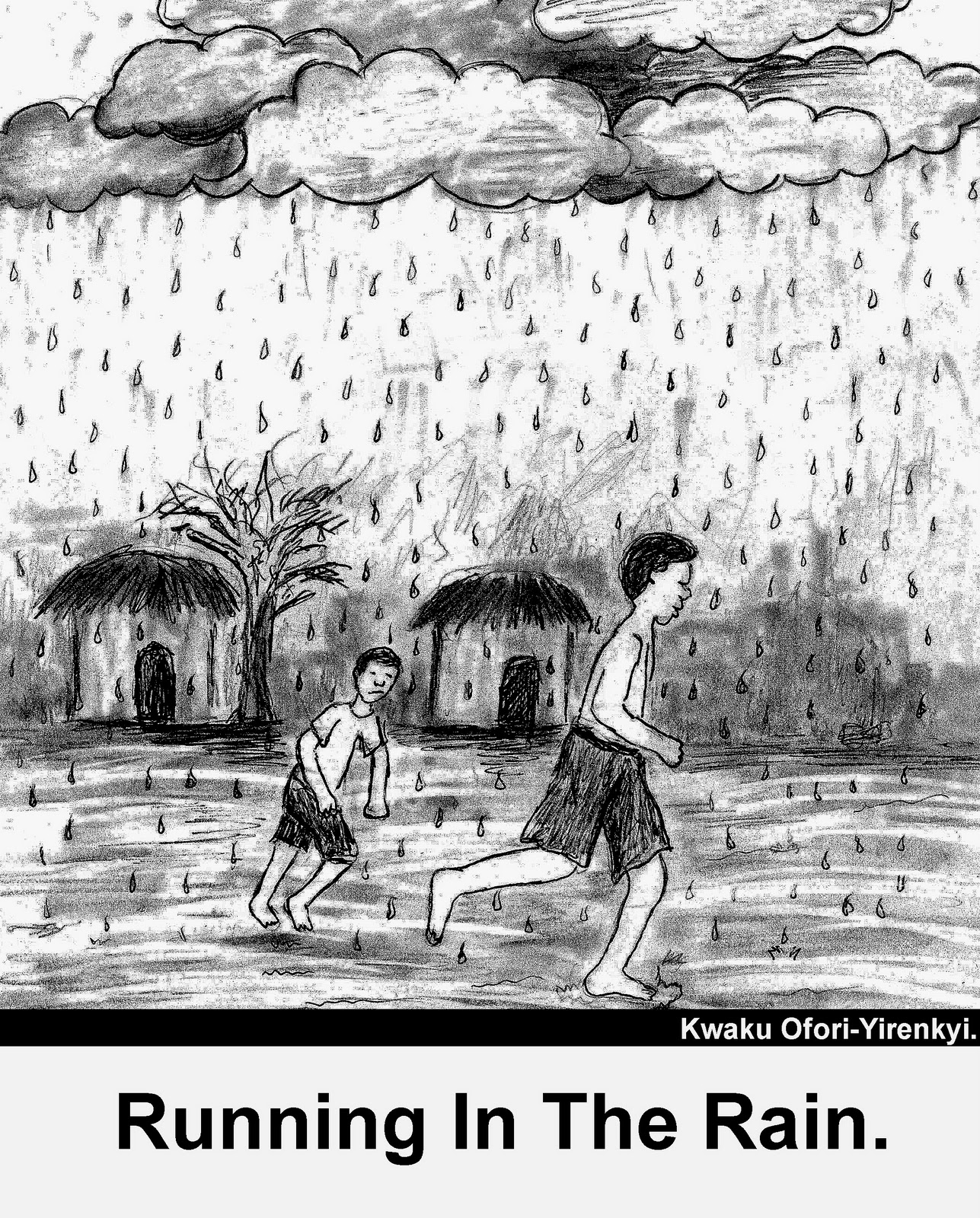
Would you run barefooted in the rain?


Magical things happen the moment you become human. You breath, you cry, you laugh, you love, you sweat, and you remain in motion. But while in motion, it’s important to periodically pause to smell the roses in the midst of experiencing the thorns of life, the heart-warming loving, the rib-cracking laughter, and the heart-breaking crying.

Life is too short. Don’t just sit around waiting for someone – anyone, especially when you know in your heart and out of experience that the person might not show up. In the same vein, because life is too short, don’t just sit around doing nothing – nothing, just laying about with all hope lost. Get up and do something – anything, so that life does not pass you by. Life, this life, is not a dress rehearsal. This is it!

Ask yourself, ‘What can make you run in the rain when thunder is booming and lightning is threatening?’ If you figure it out, just do that thing. Also, ask yourself another enduring question: ‘What makes you come alive?’ If you figure it out, just do that thing. Ghana needs people who have come alive. Whatever makes you so restless and passionate to get up and run through the rain are the things you can dare yourself to do which in your normal comfort zone, you’ll never attempt.

The driver s of life are those things that make you come alive, that fires up passion so great within you that you’re ready to do things considered a little stupid. When that thing fires you up, all you do is to get up to move and to act. It is when you’re fired up that you’re able to reach beyond yourself with a determination to dare yourself, to succeed, and to live. This principle applies to careers, education, and believing in something or someone. Life’s journey unfolds when you invest into life with energy, attention and passion.

This passing year 2010, you might have heard of people who died suddenly for unexplainable reasons and you’ve wondered – eh, why! Two days before Christmas, a five year-old boy died in his sleep after a short illness. My heart broke. You might have seen in the newspaper obituary pages deaths of people of varied ages – the young and the old. Death is no respecter of persons, and of ages. When the death bell tolls, it welcomes all. Life can get shorter than we think.

I hold this strong belief that the cemetery is filled with graves of people who did not live out their lives to the fullest. As plans were being made, as disappointments were being endured, as dreams were being suspended, as loves were being rejected, as hearts were being broken – the death bell tolled and snatched the unsuspecting. That is just the way of life – not a dress rehearsal.

This passing year, you might have made plans and nurtured good intentions which fell in thorns by the stony roadsides of life. As a result, your year did not unfold as you envisioned. You did not unravel. The year 2010 passed you by and now that it’s over, you might be wondering – ‘Where did my life go?’ So would you dare to run barefooted in the rain in 2011 in a grand cross-over effort to dare yourself to do more?

Some of us simply live on the veranda of life. These are the balcony people – easily forgotten by those at the high table in the main hall. The balcony people, those in the porches and backyards, are easily exposed to the vagaries of the weather – rain, wind and the hot tropical sunshine. Many a time, the journey from the veranda to the living room can be so tough. The escape route from the veranda to a better place might be to simply jump into the hard-hitting tropical rain, barefooted and run, hoping against hope.

Life can be likened to the familiar comfort of sitting in an old couch with the springs collapsing and the stuffing sticking out. For some of us, although that old couch gets us nowhere, yet, we remain stuck to its old comfort. But there comes a time when we must throw away the old couch and dare ourselves to try other things with a firm conviction that life is short.

Life can also be likened to an old pillow. Some pillows are so tired and stinky, harbouring the germs, the dirt and the drooling of the ages. Although familiar, they must be thrown away because of over-usage that has rendered it unhealthy, flat and hardened with the stuffiness long gone.

The old couch and old pillow hold both good and bad memories. There is safety in the familiar, yet a fully lived life must go beyond the old couch and the old pillow. For some of us, including me, abandoning old pillows and old couches might be the only way to have a jump-start on life and by that, launch successful reversals to old familiar habits and appearances of quitting on life, quitting on love, quitting on hope, and quitting on dreams.

Yes, running barefooted in the rain exposes you to the vagaries of the elements, unprotected and leaving you next to nature. You might step on a nail and the tropical rainfall would beat you mercilessly, while the thunder and lightning threaten. But at the end of it all, you can shrug off the rain water, dry yourself up, and move on to newer and probably, better things. Then, someday, because you dared to confront life, you would celebrate the rain.

The lyrics of one songster, Aaron Tippin, goes: ‘Let's love like there's no tomorrow. Live for every moment. Laugh at least a little every day. It’s impossible to say if we’ll see the sunrise in the morning.’ How so true these precepts! These lyrics present three powerful principles to live by. They are: love, laughter and living in the moment.

Living in the moment, in the now, is so difficult because some of us spend excessive amount of time dwelling on yesterday’s pains and hurts and disappointments while the present moment with its possibilities passes by, never to return. We forget that what we always have for sure is now. We’re not guaranteed the next moment, the next day, the next week, the next month, the next year, the next decade.

When you love someone, enjoy the heart journey. We’re not guaranteed life to see the sunrise or the rainfall the day after today. And laughter makes life easier because if you don’t laugh, you would cry about the downs of life. Despite the storms of life, a healthy sense of humour brightens the dark corners.

My dear reader, I wish you a very happy and prosperous New Year. As for me, myself and I, we might set out to learn to dance ‘agbadza’ in 2011! Watch out! I might break-out dancing perfect ‘agbadza’ at a location near you sometime on the journey of 2011. On your part, find something challenging, fun and extraordinary to do in 2011 – something that is definitely outside your comfort zone – because whatever makes you come alive is what will drive you to run in the rain, barefooted.

Monday, December 13, 2010

Trivialities are breaking our backs

The mass media are guilty of propagating trivialities in our national discourse. But our leadership, also known as the political elite, are guiltier of pushing trivialities into our national discourse. The followership, also known as Ghanaians, especially the category known as foot soldiers, serial callers and their cousins the social commentators, are also very guilty of giving out little-thought-out, sensational, trivial, sound-bite, chest-clearing commentaries into FM radio space.

Trivialities are unimportant, inconsequential, insignificant, frivolous, marginal, petty, slight, minor, trifling and negligible issues/things. But considering our current state of national funk and under-development, our needs and our thoughts and our focus must be top-heavy on things that are critical, very important, necessary, vital, essential, crucial, decisive, strategic, as well as urgent and of the essence.

Come along with me for an eye-popping eavesdropping session on conversations in Ghana, a country that God in His own wisdom and kindness has chosen to bless and maybe, just maybe, make great and strong. Be a fly on the wall, but don’t sit still. Periodically, shine your eyes like flies do with their ‘forearms’. Have you watched flies lately? They are fascinating. Listen in below.

Honourable Avleh: “How dare anyone give us larger than life Honourable parliamentarians grades? We would stop any journalist who tries to touch us even if he/she is from the New York Times, Financial Times, BBC, CNN or Al Jazeera. We are powerful and would stretch forth our long hands into the world to teach journalists a big lesson. If anyone touches us, we would explode to boiling point, with temper tantrums and egos flying very high. Do they know who we are?”

Eva Amponsah: “Oil will come soon. Then, all of Ghana’s problems will be solved. But have you heard the latest news? The President returned to Ghana so Dr Grace Bediako, the female statistics ‘whiz kid’, can personally count him. Wow! How nice! This country is really getting somewhere. Ghana is better. Join me to sing the Better Ghana Agenda mantra. La lala lala. See? It’s a cure-all for our ills.”

Kofi Zuzulibubu: “I say Taflatse taflatse ten times to crude oil. Let’s just go shopping with the crude oil money. Let’s spread our country’s wealth. Let’s shop until we drop. A little from China. A little from India. A little from Korea (South, that is). Sorry, we already have the STX housing ‘deal’ with Korea so we’ve already shopped out and dropped on hard floors of Korean corridors with land, access roads, bla bla bla all free of charge!”

Naa Amakey: “But this flood in the north! His Very Excellency Mills has not gone there yet. But who cares! During the former Very Excellency President Kufuor’s time, he too did not visit the north during the flood. So it’s a one-one draw! Kufuor had an accident. Rawlings had an accident too. Or, he didn’t?”

Musah Alhassan: “Our Mother the Madam should become the President of Ghana. Look at Madam Rawlings. So gorgeous! Even her head gear alone can solve all of Ghana’s problems. Our Father the Founder ruled for only nineteen and a half years. We need more. We no go sit down. We shall fight until our Mother takes over the throne.”

Nyarkoa: “Our Presidential Palace should not be called Jubilee House. Flagstaff House is better. We should make the residents of the capital city of the American state of Arizona jubilant by naming our ‘state house’ after their city. Do you know that most North American residents on the East and West Coast know next to nothing about Arizona let alone its capital city Flagstaff? So we should glorify Flagstaff.”

Kwaku Ofori: “Our two leading political parties, the NDC and NPP, are very much like the Accra Hearts of Oak and Kumasi Asante Kotoko. They are our political Hearts and Kotoko. Rivalry between them is stiff and ruthless, but fun. Eh, so when are they going to settle down to the real and urgent task of nation-building?”

Paulina Bansah: “Our big men are buying state lands left right and centre. Some of them are knuckle-headed, with stomachs like that of pregnant women, with heads as ugly as dry coconuts. When would they ever learn that Ghana belongs to all of us? Greedy Bastards! Na who born dog?”

Teacher Appa: “I’m an opinion leader of foot soldiers. It’s true that some bands of young men could on any day sweep through town to ‘seize’ public toilets and lock out a government office. But it’s a legitimate thing to do. Our party is in power. After all, the NPP people did it to us, so this is our turn. The toilets belong to us. We would show them power.”

And so goes our trivialities-charged national discourse, day in and day out. No inventive solutions are in sight for our myriad national problems. These trivial issues are bruising our sense of focus. Our distractions are too numerous to create the kind of space that can change the circumstances of our dear country. More often than not, year in and year out, one party in and one party out, it feels as if Ghana is a directionless ship that floats on a vast ocean.

Unfortunately, in the above made-up but close to real life loose train of thought from our national air space; there is not one word of science; not one sentence of technological advancement; not a cough about our sewage system; not a sneeze about solar energy considering our God-given gift of over-abundant sunshine; not an itch about poverty considering the number of our people who go to bed hungry; and not an urgent bowl movement over the fact that the number of young people who sell made-in-anywhere products by roadsides have increased.

We are fast becoming a nation of trivialities and the two leading political parties, the NDC and the largest opposition recently-ruling NPP give the appearance of being champions of trivialities.

How do we move this nation forward when we don’t seem to have focus? How does a country yank millions of its people out of desperate stinking poverty when what is constantly on its radar is talk about who is insulting whom from the vast repertoire of insults and sound-alike insults?

How does Ghana “Roll back malaria” so that none of its children die before their fifth birthdays? When do our leaders focus on the nation’s development when even those in quasi-political office desire and at times, demand to be called Honourable to their ego-filled personhood?

Arrogance is weighty. Back-breaking arrogance is crushingly painful. When impudence joins forces with arrogance, the outcome is grand haughtiness. So it is that public pronouncements from some functionaries of the NPP during their term in office, and now of some office holders of the ruling NDC render the two parties as champions of trivialities.

The current environment is intolerable – unless you turn off your radio and shut off the mass media, and completely tune off the petty ranting and tantrums of grownups.

The cautionary tale of Jenkins Scott

No condition is permanent. You may be up today but down tomorrow. Or, you may be down now wondering when it would be your turn and then one day, unexpectedly, your dim light begins to shine and you begin a joyous journey up.

Ups are sweet places; high-flying and eagle-like on strong wings, floating in the skies. But lows! Who wants the lows! But even though we don’t desire lows so zoom our prayers on the highs, there comes a time when the lows descend on us with reckless abandon. Some lows can be too low for words to describe. So when I came across the story of Jenkins Scott in the Liberian media, it got my full attention. He went from a very high-high to a very low-low.

The story of Major Jenkins Scott is such a powerful cautionary tale with layers upon layers of lessons for all. Folks who are on their lows can learn useful lessons from Jenkins Scott on how not to behave if they’re ever graced with the chance to rise above their current funky stations in life. People who are currently on their way up in society would learn to pause to smell the roses. Those who are currently on the highs in life would need to do a whole lot of pausing to reflect.

Who is Major Scott?”

He was powerful; a lawyer who became the Minister of Justice of Liberia after the People’s Redemption Council (PRC) of Samuel Doe successfully overthrew the True Whig Party in a bloody military coup d’état on 12th April, 1980. Stories about Jenkins Scott are legend and grim. Yes, he was hailed by some but many saw him as the devil incarnate – wicked, ruthless, callous and a champion of excesses of atrocities including alleged and unspeakable bloody murderous human rights abuses like mutilations.

He is also accused of being one of the central characters who planted the seeds that led to the bloody civil wars in Liberia. Jenkins Scott was Justice Minister when opposition figure, now President Ellen Johnson Sirleaf, was thrown into prison. Several journalists were also imprisoned without trial as ‘enemies of the state’ during the lawless and brutish Doe regime.

Scott was feared, as such people are feared. It is said that power corrupts and absolute power corrupts absolutely. A man I spoke to described Major Scott as follows; ‘Just the mention of his name brought fear.’ So the Minister of Justice had a reputation for abusing justice.

Ghanaians alive and politically conscious in the 1980’s can relate to this story of fear of leaders. At the mention of some names, at the sight of a soldier with a gun, knees wobbled and hearts palpitated; even manhood feminized. Ghanaians suffered their own atrocities in the 1980s. The West African region was heated up by adventurist soldiers who toyed away with the lives and fate of their citizenry. That was the era of Major Scott in Liberia.

But on Saturday, November 6, a reporter of one of Liberia’s leading newspapers, the New Democrat, discovered Major Scott asleep in a pile of garbage in the neighbourhood of the Temple of Justice, the magnificent building in Monrovia that houses the Supreme Court. He was hungry, thirsty and dirty. The irony is that one of the most powerful ministers of justice ended up in a pile of ‘bola’ at the justice ministry – his former empire. What a cruel joke life can play on the unsuspecting!

Photographs of Scott I’ve seen dated as recently as 2008 depict him as doing well. One of them even carries a caption quoting him as saying, ‘I want to be Liberia’s Ambassador to The Kingdom of Saudi Arabia.’ The details of what happened in the two-year period from ‘I want to be Ambassador’ to I’m laying in a pile of garbage, hungry, thirsty and dirty is at best, murky and eye-popping. Probably, something mental was already simmering inside of him all along from the effects of war.

Beyond morality, beyond thoughts of ‘it serves him right’, there are lessons for a county like Ghana that has not been to war. The hard frightening fact is that a war might be waged for a short period but the spill-over of war could take generations to cure and clean up. Seven years after the two senseless civil wars, one can visibly see the scars of war in Liberia on buildings with glaring bullet holes. Some of these buildings seem to stare at you and whisper, “We were victims too! We have bullet holes to show for the merciless pounding.”

The bullet holes in some buildings have been patched. Yet, when you look closely beneath the patchwork of cement, you can still see the scars left behind. If walls made of concrete still bear witness to war, what about the scars left behind in people’s hearts and minds?

Enters the results of research:

The results of two separate studies of Post-Traumatic Stress Disorder (PTSD) conducted in Liberia by Harvard University in 2008 and 2010 will make your blood freeze about the long-term effects of war. Here are two key conclusions. (1) People exposed to extreme violence suffer mental disorders later in life. (2) Liberians who were exposed to sexual violence (rape) during the war suffer more mental health disorders after the war than those who were not.

Here are some mind-numbing statistics. In the 2008 study of an adult household-based population, 40 percent of respondents were found to have symptoms of major depressive disorder, 44 percent with symptoms of PTSD, and eight percent were found to suffer from social dysfunction. Of those studied, 33 percent had served time with fighting forces. The results of the studies suggest that sexual violence impacted on both males and females during the Liberian civil wars.

One of the studies found that villages that had experienced greater suffering from the war had a higher prevalence of PTSD than villages that did not suffer much during the war. The researchers found that surprisingly, individuals who were not even combatants of the war because they were very young at the time, also showed high prevalence of PTSD.

The physical wars have ended but the psychological war endures – in the mind. War is traumatic both physically and mentally – what is known as psycho-social trauma. The 14 year civil wars spanned the period between 1989 and 1997 and 2003 to 2004. Jenkins Scott was at the centre of the violent regime. Who knows what he did? Who knows what he witnessed? Who knows what he ‘directed’ to be done and watched as they were being done? A lot must be stuck in his mushy tissue – the brain.

So key questions being asked in Liberia include: “Is Jenkins Scott crazy?” Why did he end up in a garbage pile at his former empire office?

So what for Ghana?

Speak peace to Ghana. If during the 2012 ‘Crude Oil” Elections, naughty blood-thirsty loud-mouthed low-cost individuals run their stinky mouths on radio stations beating war drums, bragging that if their political party does not win, they will burn Ghana and let the blood flow, yell into their ear drums, “Tofiakwa, NO WAR FOR GHANA!”

Friday, December 10, 2010

Thinking Hutzpah over coastal West Africa

What is a Promised Land? Who promises what to whom? Does luck have a place in a promise? Or is it just like beauty that resides only in the eyes of the beholder? When and how does one get to know for sure that something he/she has is a promise? How does one handle a promise once it has been identified as such?

What makes a piece of land, or vast stretches of it, worthy to be considered a promise? Is it the quality of the land that makes the owners think that they have been blessed? Can one get something out of nothing? Or, get nothing out of something? The land of Israel is unlike ours – dry and stony, yet it is considered a treasure. These thoughts flooded my mind while I gazed at the land from an Air Nigeria (formerly Virgin Nigeria) flight from Kotoka to Liberia’s Robertsville International Airport.

Flying over Accra on a cloudless day is too revealing. It becomes obvious beyond all reasonable doubt that our capital city has over-grown and does not make sense. Something is happening to Accra. A nameless, formless, shapeless, unrecognizable and cacophonous something is happening to the town of my birth!

Accra spills over from east to west; from north to south. It is bursting at the seams. It is as if most of the villages and towns of Ghana have packed baggage and garbage, re-located to, and congregated in Accra for a big conference that has no end date. It’s an open-to-all sort of conference so all are welcome. Accra seems to be saying to Ghana – ‘Bring me all your mansions, your shacks, your hamlets, your poor, your funk, and I’ll give thee rest.’

Apart from some pockets of well-laid out areas, the aerial view of Accra, what you see from above the ground while airborne -- is as chaotic as what you see when on land. The nature of growth of this city is crying for structure, for order, and definitely for a whole lot of planning. Where are the elders of the town of my birth?

As the Air Nigeria flight, which is fast losing its virginity, continued the journey westward over Cote d’Ivoire, the beauty of the land became striking. Vast stretches of green upon green land hit me. It spelt agriculture. It gave the impression of a ‘food basket.’ The masculinity of the lush green forest, entangled with the femininity of its softness, took my breath away and made me feel that God’s glorious hands are in this.

The knowledge that the land is not only fertile but also endowed with varied mineral resources made me smile. Large meandering rivers, brown in colour, dirtied from misuse and abuse, gorgeously snake through the land on their uneventful journey to pour it all out into the mighty Atlantic Ocean. It’s the same ocean that ferried millions of unwilling children of West Africa into dehumanizing slavery to toil to advance other people’s civilization whilst ours remains stuck in underdevelopment funk.

But then quickly, the sense of recent history dawns and the reality struck -- this is no food basket at all. This is a jungle; a jungle in which poverty hugs with thorns. A jungle in which atrocities occur! A jungle in which some of the inhabitants are stuck in hopelessness! A jungle that is gifted with so much that is yet to be explored for the benefit of the majority of its people. Still, a jungle! The regional land of my birth.

Soon, the flight began the descent into Liberia – more land with lush green forest; a country in which it rains ‘by heart’. It is as if one can plant the eye of a fish and it would germinate! But the reality hovers below the clouds -- that this country is bruised; it went through two senseless, destructive civil wars that lasted fourteen years.

Throughout the less than two hour flight, thoughts of hutzpah flooded my mind. If only hutzpah could be sprinkled from an airplane over coastal West Africa! If only everyone would swallow a little bit of hutzpah! If only I could find my own hutzpah! The thoughts of hutzpah gave me flashbacks.

About fifteen years ago during life’s journey, my deputy at work was an American woman of Jewish descent named Stephanie. One day, she said something to me that was at once disturbing, yet thought-provoking. She remarked, ‘Doris, you have everything you need to achieve greatness, with the exception of one key ingredient.’ The remark startled me. In my taken-aback mode, I asked her, ‘What do you mean?’ Her response was prompt and matter-of-factly; in just one word – ‘Hutzpah!’ I retorted, ‘W-H-A-T?

I swallowed my pride and hurt to engage in a deep but confusing conversation about ‘hutzpah’ (also spelt chutzpah or huspa). Stephanie’s grandmother was a Jewish girl who survived Hitler’s Holocaust in Poland and migrated to the USA. Over six million Jews perished at the mercilessly cruel hands of Hitler and his Nazi associates in a grand effort to wipe them out of the face of the earth. Yet, they continue to endure – and to thrive.

The story of the success of the Jews is not talked about much. Some explain it away from only a Biblical point of view – that God blessed them. But there is something I wish I could put hands on about why the Jews have been successful throughout history whilst Africa fails? Dear reader, if you have this knowledge, please share it with us. ‘Hutzpah’?

So it was that a granddaughter of a holocaust survivor (1938-1945), my assistant at work, had observed me for a little over a year and her bold verdict was that I needed hutzpah to crank up my life! She explained that there is no English word that can fully define this thing called hutzpah, a Yiddish word, and a vernacular of the Hebrew language. The closest English words are guts, courage, bravery and audacity. But the unique characteristic of hutzpah is that it is not given. It can only come from the depths of one’s own insides.

Over the years, I’ve come to believe the importance of marshalling ‘hutzpah’ to pull off challenging tasks. There are certain tasks that can be accomplished in a casual mode by putting in average effort. But it requires a lot of hutzpah to solve really challenging, stubborn and difficult tasks, and hard-crusted problems – like ours.

Hutzpah does not come easily. It can only be marshalled with resilience and a determination to think and believe ‘Yes, I can’ even when you know that you can’t. When all the evidence suggests that you can’t accomplish a certain feat, when all odds seem to go against you, that is when a still small voice lying dormant from the depth of your being, should whisper to you, ‘Yes, you can!’

As hutzpah thoughts enveloped me, I wondered when West Africa would marshal its hutzpah and yank itself out of under-development funk. But selfishly, I wondered when I would finally find my own hutzpah. Perhaps, I would find it in Liberia. And with those thoughts, I got off the plane to head toward rainy Monrovia.

dorisdartey@gmail.com
+233208286817